
WELCOME BONUS 100%
UP TO €500 + FREE
BET
UP TO €500 + FREE
BET
Home → Blackjack
Blackjack at StarBet Liberia: Variants, Rules and Payouts
RNG draws cards from virtual eight-deck shoe
The RNG implementation utilizes a virtual eight-deck shoe for standard Blackjack games, establishing the baseline probability structure for all digital hands dealt to players. This specific configuration directly influences the mathematical edge, as fewer decks typically reduce the house advantage by approximately 0.02 percentage points compared to single-deck variants.
In contrast, the Liberal Vegas Strip variant uses more favorable rules to achieve a superior RTP of 99.72 percent with a house edge of just 0.28 percent. This combination of Soft 17 standing and resplitting aces creates a significantly better long-term expectation than the standard eight-deck game, which carries a 0.46 percent edge.
Players relying on basic strategy in the standard eight-deck game must account for a 0.46 percent house edge, meaning they lose 0.46 euros for every hundred euros wagered over time. This statistical reality distinguishes it from single-deck games that offer a lower 0.15 percent edge but often compensate with less favorable payout ratios like 6:5 instead of the standard 3:2.
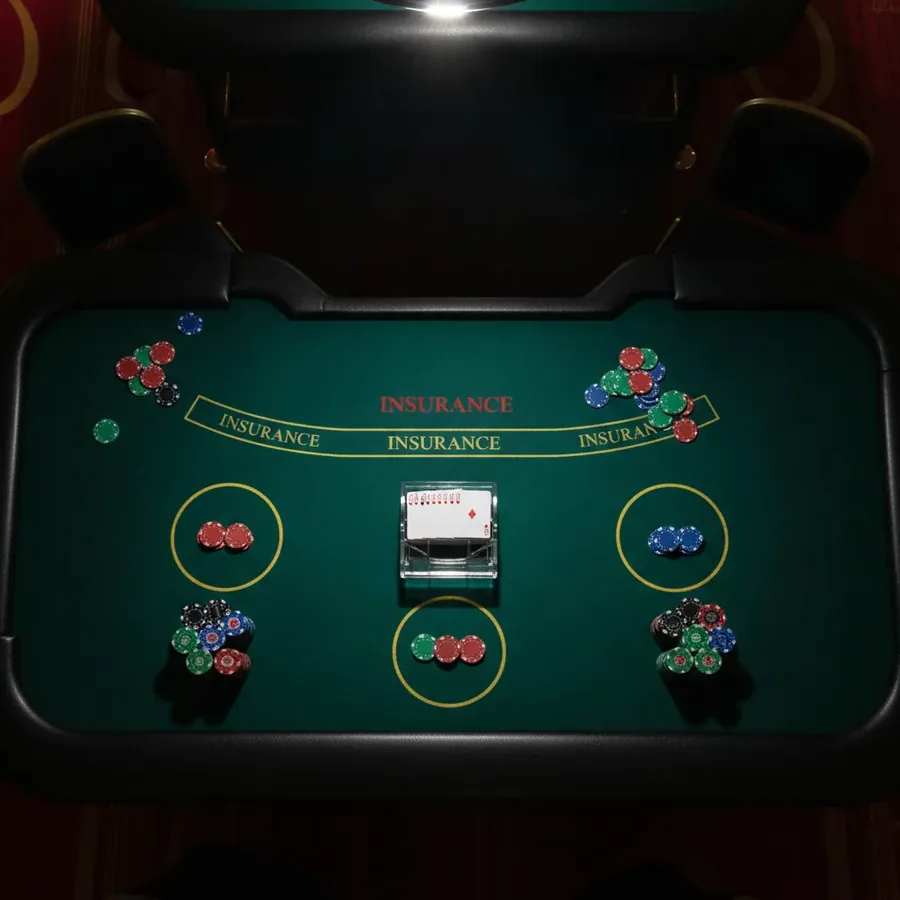
Even Money only possible with Dealer Ace
Even Money is an insurance side bet offered exclusively when the dealer shows an Ace, allowing players to secure a 1:1 payout immediately if the dealer also has Blackjack. This option effectively locks in the main bet's value before the dealer checks their hole card, removing the risk of losing the entire stake on that specific hand.
The cost of this protection is significant, as the Insurance bet carries a steep house edge of 7.47 percent, resulting in an RTP of only 92.53 percent for those who choose it. Basic strategy dictates that players should always decline this bet unless they are counting cards and the true count reaches +3 or higher.
For a player betting ten euros, accepting Even Money guarantees a fifteen euro return regardless of the dealer's hidden card, whereas declining risks losing the ten euros if the dealer has Blackjack. This immediate payout contrasts sharply with the potential loss, making it a mathematically inferior choice for most strategic players over the long term due to the high house edge.
Insurance vs Even Money on Own Blackjack
When a player holds a natural Blackjack against a dealer Ace, the concept of Even Money merges with the insurance mechanic, offering a guaranteed profit equal to the original bet. This ensures a net win of one unit regardless of whether the dealer reveals a ten-value card underneath, eliminating any variance from that specific hand outcome.
However, taking this guarantee is statistically disadvantageous because the underlying insurance bet has a 7.47 percent house edge and a poor 92.53 percent RTP. By locking in a small profit now, the player forfeits the opportunity to win 1.5 units if the dealer does not have Blackjack, which occurs more frequently than the five-to-twelve odds suggest.
Declining Even Money on a player Blackjack yields a thirty euro profit on a twenty euro bet if the dealer lacks Blackjack, totaling a larger eventual gain. Accepting it limits the win to exactly twenty euros plus the original stake, effectively paying a premium to avoid a likely scenario where the dealer misses, thus reducing overall expected value.
Register Late Surrender correctly in three steps
Late Surrender allows a player to forfeit half their bet after the dealer has checked for Blackjack, providing a crucial reduction in the house edge by approximately 0.08 percentage points. This rule applies only when the dealer does not hold a natural, ensuring the player loses only fifty percent of their original stake rather than the full amount.
To utilize this feature correctly, players must first confirm the dealer has no Blackjack before deciding to surrender their hand, which typically consists of a hard sixteen against a nine or ten. This timing is critical because Early Surrender, which is far more valuable with up to a 0.6 percent edge improvement, is extremely rare in online casino environments.
The financial impact of surrendering is immediate, as the player retains fifty percent of their wager while ending the round without further action. This mechanism improves the overall RTP compared to hitting or standing on marginal hands, offering a strategic escape route that significantly mitigates losses during unfavorable dealing conditions.
Blackjack doesn't count for every bonus offer
The 300 percent welcome bonus up to two thousand euros requires wagering contributions that vary significantly by game type, with table games like Blackjack contributing only ten percent toward the turnover requirement. This low contribution rate means that playing Blackjack is substantially less efficient for clearing bonus funds compared to slots, which contribute one hundred percent per wager placed.
For instance, wagering one hundred euros on Blackjack counts as only ten euros toward the total turnover needed to unlock the bonus withdrawal, whereas the same amount on slots counts fully. This discrepancy forces players to either play a much higher volume of table games or mix in slot gameplay to meet the requirements within the allowed time frame.
The disparity in contribution percentages makes pure Blackjack strategies inefficient for bonus hunting, as the effective wagering burden is ten times higher than for eligible slot games. Players seeking to maximize the utility of the two thousand euro bonus cap should prioritize high-contribution games to minimize the total amount of money risked during the clearance process.
Blackjack variants at a glance
| Variant | Payout | House edge | Rule | Bet range |
|---|---|---|---|---|
| Blackjack Surrender (Late Surrender) – Regel-Effekt | n.a. (Regel-Modifikator) | −0.08 Prozentpunkte | Spieler gibt Hand nach Dealer-Blackjack-Prüfung auf, verliert die Hälfte des Einsatzes. Verbessert RTP um ca. 0.08 Prozentpunkte. Early Surrender ist wesentlich wertvoller (bis −0.6 Prozentpunkte), aber extrem selten. | Rückzahlung 50% des Einsatzes |
| Blackjack 6 Decks, S17, DAS, DOA, Auszahlung 3:2, Basisstrategie | 99.54% | 0.46% | Dealer steht auf Soft 17; Verdopplung auf jeder Zweierkarte; Verdopplung nach Split erlaubt; keine Aufgabe. Basisstrategie ist für diesen Wert zwingend | Blackjack 3:2, normaler Gewinn 1:1, Insurance 2:1 |
| Blackjack Auszahlung 6:5 statt 3:2 (6 Decks) | 98.15% | 1.85% | Ersatz von 3:2 durch 6:5 fügt exakt +1.39 Prozentpunkte zum Vorteil des Casinos hinzu – stärker als jede andere Regeländerung. Bei $10 Einsatz zahlt Blackjack $12 statt $15. | Blackjack 6:5, Gewinn 1:1 |
| Blackjack Ein Deck, klassische Regeln, 3:2 | 99.85% | 0.15% | Weniger Decks = niedrigerer Vorteil; ein Deck gibt ca. −0.48 Prozentpunkte gegenüber 8 Decks. Oft durch 6:5 Auszahlung kompensiert. | Blackjack 3:2, Gewinn 1:1 |
| Blackjack Insurance / Versicherung (6–8 Decks) | 92.53% | 7.47% | Separate Nebenwette bis 50% der Hauptwette, wenn der Dealer ein Ass hat. Basisstrategie schreibt IMMER Ablehnung vor (außer Karten zählen bei True Count ≥ +3). Bei einem Deck Vorteil ≈ 5.88% | Insurance 2:1 |
| Blackjack Split / Double / H17 – Regel-Effekte | n.a. (Regel-Modifikatoren) | H17 +0.22 Prozentpunkte; RSA −0.08 Prozentpunkte; DAS −0.14 Prozentpunkte | Dealer Hits Soft 17 verschlechtert RTP um 0.22 Prozentpunkte; Resplit Aces verbessert um 0.08 Prozentpunkte; Double After Split verbessert um ca. 0.14 Prozentpunkte; 6 Decks statt 8 – ca. 0.02 Prozentpunkte. | Double – Einsatz ×2 mit einer Karte; Split – bis 4 Hände; Ass-Split meist mit einer Karte. |
Bonus conditions often exclude Blackjack completely
The 300% welcome bonus up to €2,000 plus 100 free spins applies primarily to slots which contribute 100% toward wagering requirements. Table games like blackjack count only 10% toward the same turnover target, making them inefficient for clearing the bonus funds. This structural disparity forces players to choose between high contribution rates on slots or lower contribution rates on table games. Consequently, using a €2,000 bonus on blackjack requires generating significantly more wagering volume than playing slots.
Blackjack Surrender acts as a rule modifier that improves RTP by approximately 0.08 percentage points but does not alter the game's exclusion status from bonus contributions. The Late Surrender rule allows players to forfeit half their stake after the dealer checks for blackjack, reducing long-term losses slightly. However, this specific mechanical advantage remains irrelevant if the player cannot legally apply the bonus funds to such tables due to strict casino terms. Players must verify if their chosen variant falls under the restricted category before depositing.
No Double Down on three cards
Blackjack 6 Decks permits doubling down on any two-card hand and even after splitting pairs, yet it strictly prohibits doubling on three or more cards. This restriction limits strategic flexibility compared to variants allowing multi-card doubles, potentially increasing the house edge if basic strategy relies on such plays. The standard payout remains 3:2 for natural blackjacks, while regular wins pay 1:1, maintaining traditional expectations for successful hands. Players adhering to optimal strategy must adjust their betting patterns when dealt three-card totals in this specific variant.
Soft 17: Dealer Hits or Stands
Dealer standing on Soft 17 reduces the house edge in Blackjack 6 Decks to 0.46%, whereas hitting on Soft 17 increases it by 0.22 percentage points. This single rule change significantly impacts the theoretical return, shifting the balance between favorable and unfavorable odds for the participant. Blackjack Liberal Vegas Strip also features S17 rules, contributing to its lower house edge of 0.28% through other liberal modifications. Understanding whether the dealer hits or stands is crucial for calculating the exact expected value of each hand played.
What Push Means: Stake Returns to You
A push occurs when the player and dealer tie with equal hand values, resulting in the original stake being returned without profit or loss. This outcome effectively neutralizes the round, preserving the bankroll until a decisive result emerges in subsequent deals. In games with 99.54% RTP like Blackjack 6 Decks, pushes are integral to the long-term statistical model despite offering no immediate gain. Players should anticipate these ties as standard occurrences rather than errors, recognizing their role in maintaining the game's mathematical equilibrium.
What a Natural Blackjack Practically Pays Out
A natural blackjack typically pays 3:2, meaning a €10 bet returns €15 in profit plus the original stake, totaling €25. Some variants offer reduced 6:5 payouts, which drop the return to €12 profit on a €10 bet, drastically worsening the house edge to 1.85%. Lightning Blackjack maintains the 3:2 structure while adding multipliers up to 25x for winning hands, enhancing potential payouts significantly. Quantum Blackjack Plus Live also supports standard payouts alongside quantum multipliers up to 1,000x for three-card combinations totaling 21 points.
Bonus Lost Due to 10 Percent Contribution
The welcome bonus provides a maximum of €2,000 alongside 100 free spins. Table games contribute only 10 percent toward the wagering requirement, whereas slots count at 100 percent. This restriction means blackjack plays are largely ineffective for clearing the bonus funds.
A player who wagers €100 on Lightning Blackjack adds merely €10 to the turnover total. The casino retains the remaining €90 of that bet as non-contributing activity. This discrepancy significantly extends the time needed to convert bonus credits into withdrawable cash.
Consequently, the effective wagering burden increases by a factor of ten for table game players. A €2,000 bonus requires €20,000 in blackjack bets instead of the standard €4,000 if played on slots. Players aiming to utilize the full bonus amount must prioritize slot machines over live dealer tables.
Double Down vs Simple Hit on 11
Doubling down on an 11 against a dealer ten yields an expected return of 54 percent. A simple hit produces a lower return of 53 percent for the same hand scenario. The one percentage point difference favors doubling despite the increased risk exposure.
This calculation assumes optimal play within a six-deck shoe with soft 17 rules. The house edge for this specific configuration stands at 0.46 percent when using basic strategy. Deviating from the double-down instruction increases the long-term loss rate slightly.
Players should always double on 11 unless the dealer shows an ace or ten in some variants. Resplitting aces and doubling after splits further optimize the expected value. The statistical advantage remains marginal but consistent across all qualifying hands.
16 vs 10 played incorrectly: most common error
Hitting on a hard 16 against a dealer ten results in a 62 percent bust probability. Standing on this hand leads to a higher likelihood of losing the entire stake. Basic strategy mandates hitting in this specific high-risk situation to minimize losses.
Insurance bets offer a separate decision path with a 7.47 percent house edge. Accepting insurance on a 16 versus 10 is statistically unprofitable without card counting. The true count must reach +3 to make the side bet profitable for advanced players.
Correctly playing this hand reduces the overall house edge from 1.85 percent to 0.46 percent. Misplays like standing or taking insurance accelerate bankroll depletion significantly. Adherence to strict basic strategy charts prevents these costly errors during live sessions.
Unlimited seats via a split dealer hand
Lightning Blackjack by Evolution allows unlimited simultaneous players at any single table. The dealer handles multiple hands through split mechanics rather than limiting seat capacity. This structure supports high-volume betting environments without physical space constraints.
Quantum Blackjack Plus by Playtech caps individual bets at 5,000 EUR per round. Multipliers up to 1,000x apply to three-card combinations totaling 21 points. These features enhance volatility while maintaining the unrestricted seating model inherent to digital tables.
Betting limits range from 1 EUR to 2,500 EUR on standard lightning tables. Quantum variants extend the upper limit to 5,000 EUR for high rollers. The absence of seat restrictions ensures continuous availability regardless of peak traffic times.
Blackjack Payout 3:2 Explained in Detail
A natural blackjack pays 3:2 on a winning hand under standard liberal rules. A 100 EUR bet returns 150 EUR in profit plus the original stake. This ratio defines the baseline profitability for players adhering to optimal strategy.
Switching to a 6:5 payout structure reduces the profit on a 100 EUR bet to 120 EUR. This change adds exactly 1.39 percent to the house edge compared to the 3:2 variant. The RTP drops from 99.72 percent to 98.15 percent under the inferior payout scheme.
Liberal Vegas Strip rules maintain the 3:2 payout alongside soft 17 and resplitting options. Single deck games also offer 3:2 payouts but may compensate with fewer decks. Players should verify the payout ratio before sitting down to avoid excessive house advantages.
Contact
Live - online chat
Banking









Providers












StarBet Liberia 2026